
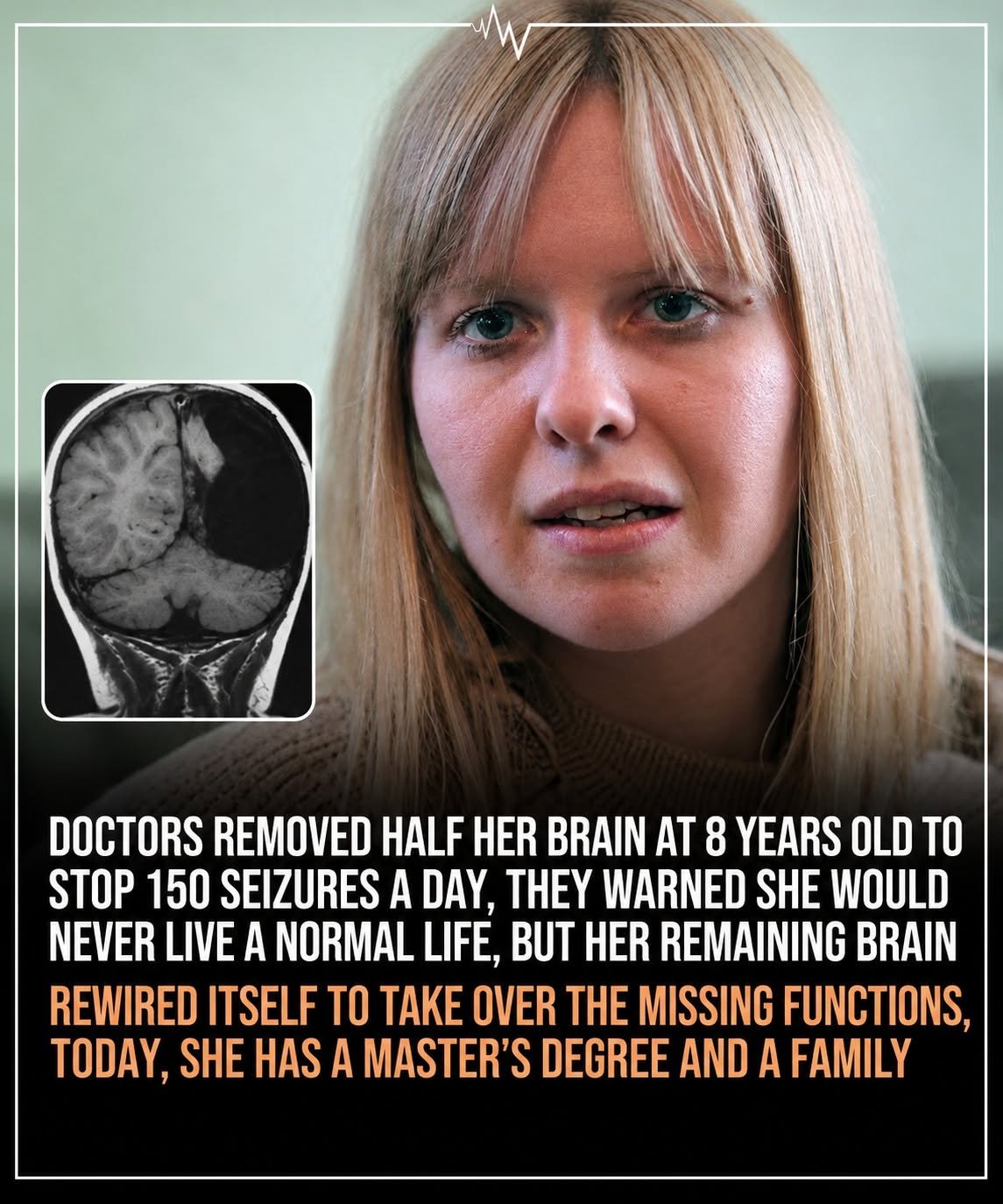
When Christina Santhouse was a child, a rare neurological disease called Rasmussen’s encephalitis caused relentless seizures that gradually took control of her life.
By the age of eight, Christina was reportedly experiencing as many as 150 seizures in a single day.
Medication could not stop them, and the disease was damaging the right side of her brain.
In 1996, doctors at Johns Hopkins performed a hemispherectomy, a complex operation that removed the affected right hemisphere in an effort to stop the seizures and protect the healthy side of her brain.
The surgery was enormous, and recovery required patience, therapy, and determination.
Christina had to adapt to physical challenges, including weakness on her left side and changes to her vision. But the seizures stopped, giving her the opportunity to build a life that once seemed beyond reach.
A hemispherectomy is one of the most specialized procedures in pediatric neurosurgery and is typically considered only in carefully selected cases where severe epilepsy cannot be controlled through medication. Although removing or disconnecting one hemisphere of the brain sounds extraordinary, children’s brains often possess a remarkable ability to reorganize functions over time, especially when supported by intensive rehabilitation.
Christina embraced that long process of recovery.
She learned to drive.
She completed her bachelor’s and master’s degrees in speech-language pathology.
She became a speech pathologist, using communication skills and clinical knowledge to help other people.
She also built a home and family of her own.
Her career allowed her to work with individuals facing communication challenges, giving her the opportunity to support others through obstacles she understood in a deeply personal way. The same determination that helped her recover from childhood surgery became a defining part of her professional and personal life.
Christina’s achievements are not evidence that every person will have the same medical outcome. They are evidence of what became possible in her individual case through specialized treatment, rehabilitation, family support, and the remarkable adaptability of a young brain.
Medical experts emphasize that every case of Rasmussen’s encephalitis is unique. Outcomes depend on many factors, including the extent of the disease, the timing of treatment, the person’s overall health, and access to rehabilitation. Christina’s experience should not be viewed as a prediction for every patient, but as one inspiring example of what can sometimes be achieved.
Her story shows that a difficult prognosis describes a medical concern, not the full measure of a person’s future.
It also highlights the importance of modern medicine working hand in hand with perseverance. Surgery alone was not the end of Christina’s journey. Years of therapy, education, encouragement from loved ones, and her own determination all played essential roles in helping her regain independence and pursue her goals.
Christina Santhouse did more than survive an extraordinary operation. She continued learning, working, loving, and creating a life defined by far more than the illness she faced as a child.
Today, her story continues to inspire patients, families, healthcare professionals, and anyone facing overwhelming challenges. It serves as a powerful reminder that while illness may change the course of a life, it does not always define its destination. Sometimes, hope begins where expectations end, and extraordinary resilience can emerge from the most difficult circumstances.